

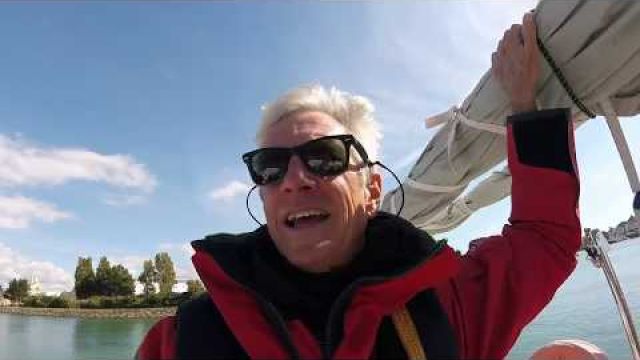
Four examples (and a blooper) under various conditions of docking my 40' Bavaria while solo. These occur in relatively light winds, but I use the same techni...
Closed Captions (CC):
[Music]
today I'm going to try to demonstrate my
normal solo
knocking procedure so that the technique
is the first thing I haven't quite
finished but I've got my mooring lines
three mooring lines on my starboard side
set I will put over the fenders in a
little while and I always lower the
spray hood because just to reduce
windage and it also improves my
visibility so I'm all set the way I do
this it's a bit shocking to some people
because it's kind of the crash method is
you come in it turned into your slip and
when you're so low you can't stop half
way in especially if the wind is pushing
you off off of the finger off of the cat
way you have to go all the way to the
end so I've got a Fender on the on a bow
and I've got two of those fenders that
are mounted to the
I'll show you our families later that
are mounted to the pontoon and I
actually have to crash into the Hat very
slowly so I try to think the key is to
keep enough way on all the way in and
then right before you hit it give a hard
reverse and then when you touch the the
fender all the way at the end then
immediately put it into forward gear and
turn the helm away from the pier that
would that away from the finger that
will lock your Stern into the Fenner and
then you can eat into the cat way then
you can take all the time you want to
put over your lines and I just leave the
engine running and your boat is locked
now the challenge is to stop you see
this is this is the view I have
you can see my anchor up in the front
there the anchor actually has to past
past the end of the pontoon when I go in
before I stop if you stop too early
especially on a day when there's wind
and I'm certainly going to show you
those on a day when there's wind if you
stop too early or people come to try to
help you and they give you this signal
slow down slow down if you do that it's
guaranteed if you you lose your nerve
and you stop too early the wind will
just push you over into that other boat
that's on the other side of your of your
your birthing space so you've got to
have the courage and the willpower to
resist people telling you to slow to go
all the way to the end
a big break reverse gear right at the
end to hopefully just glide in very very
slowly into the fender and then as soon
as you touch forward gear and reverse
helm that's what I do and you know
sometimes it's not real pretty but it
almost always always works so we'll
we'll see how this comes out okay I'm
coming up to the
final turn when I make the final turn
I'm going to have ten knots of wind
coming from four o'clock we're just
going to push me on to the other
still in first year but I'm gonna put it
to neutral right now because the wind is
gonna push me okay I'm in neutral
I'm gonna park right next to that blue
boat that you see up there
so I'm it's just the wind that's pushing
me down
down the channel now
first gear just give me a little bit of
forward gear just give me a little bit
of weight back to neutral
I start to turn in
okay now I'm eating for those two white
fenders up on the pontoon if they're on
the camera
now the trick is not to break too early
okay
now
[Music]
see I didn't touch the other boat here
and now when I put it in forward gear
I'm pressed up against the pontoon and
turn the helm away and now it's pushing
me into the finger now I just leave it
in gear I leave it in first gear and go
tie off my lines and the engines still
running so that's how it's done
now today wasn't a particularly
aggressive day Tim knots a wind which is
not too too hard when it gets above 12
or 15 certainly about 15 I
systematically touch this that's why I
put in an extra fender here to predict
so that's the technique sometimes not
very elegant but efficiently hello just
a quick recap on how I set up my boat
for coming in and out of port on the bow
I've got a bow fender here you can see
that and I'm now permanently here this
is my my berth here I mount these two
fenders so and I just drive it in I
Drive it forward until that hits it
won't knock over this water thing I've
already tested that quite thoroughly and
once it hits then I reverse the put the
helm away and drive the engine forward
the motor forward and that drives to
stern back against against the finger
here so they kept away as we call them
in France and that works fine obviously
when the wind is blowing only a few
knots or it's blowing me against the cat
way I only come down about halfway and
then I stop here and I just then step
down because there's no sense in driving
it all the way forward and this is the
same exact same setup that I use when I
visit other ports now obviously I won't
have this protection down here when I
come into other ports I just have my bow
fender and that's adequate you just have
to be a little more careful drive
a little slower but it works fine for me
now when the wind is more than 12 or
certainly when it gets to 15 knots when
I by the time I reach the end of the end
of the birthing space here the wind has
really pushed me that direction even if
I if I go with a certain amount of way
on so I try to go a little a little
faster but it's inevitable that I'm the
stern of the boat is gonna get pushed
over and quite often when there's 15
knots of wind I'll touch this other boat
here on the fenders so I've got my
fingers raked plus I bought one of these
big round ones here that you can see
there and it just goes over very gently
it may just tap that one and by that
time I've reached the end and then I
just power it across power back so
that's how I do my arrivals and
departures sometimes they're not real
real elegant I say so on some YouTube
sites that the guy at the helm picks up
a spring line and then ties it off and
it pulls the bow in but I can't do that
on my boat because you can see I'm
standing at the at the helm right now
that it's still another two meters until
I get to the end of the cat way so the
cat weighs not long enough to do that
technique here but I understand how they
do that so that's how I do it even in
visiting ports I just drive it forward
and just try to stop right before I hit
the pier works for me
now for this one I'm gonna have about
eight knots of wind that's actually
gonna be pushing me pushing me onto the
fender so what I want to do is stay a
little bit wide when I go in this time
because the wind will push me into the
fender if you into the finger if you hit
the finger you're bouncing off it and
then going into the other boat so
that'll be the challenge on this one
looking at 5.9 nuts on the nose so be
pushing me on to the onto the finger
just went to neutral
start to turn in but aim wide I don't
need to aim close to the finger because
the wind is going to push me onto it
the wind is pushing me nicely in into it
now I can just slow down and stop just
about any time
a little breeze that there is is pushing
these side of the enemy and I did just
push them push to put the motor into
gear
away
that slide in
and I just leave it like that and go tie
off the lines at my leisure with the
engine on let's go tie up the lines and
I'm all done so over to the ceiling
station here is only about three or four
knots of wind so it's this is not a
hugely challenging thing but so I'll be
back here directly into three or four
knots of wind and also there's about a
knob current that's coming as well
[Music]
well that's how I do the reversing
maneuver I love that reversing maneuver
especially if you can do it into the
wind or into a current you keep exact
control of the boat right up to the
point that you want you can just drop
the your lines over onto a cleat I
entered the channel that's leading into
they subdued alone which is a foot I've
been to many times before in fact they
don't even call them on the radio
anymore they always make a stop at the
visitors pump dome which always
irritates me so I'm heading down the
channel I need to tie up on the port
side up there and you see there's about
13 not to wind here 13 and a half knots
of wind it's gonna blow me directly off
when I blow me directly off the the home
tone that I'm trying to go tie up to so
it makes it kind of interesting because
I need to do is run up to the mid ships
I bring up myself up alongside parallel
and run up to me chips grab that line
and try to throw it over a cleat
sometimes I miss that cleat and so then
I have to go around in a circle because
up close it blows me off immediately you
don't get a chance you don't get a
second shot
you get one sometimes you get lucky and
there's someone there who will take take
the line for you and that makes it
easier but if you're over yourself
late at night or something like that
that's how you have to do it and I'm not
embarrassed to say that I've missed the
cleat and had to you know that the
baller didn't had to had to turn into a
360 and come back around the state for a
second time
twelve knots of crosswind off of the
dock and see the dock has pretty crowded
a lot of space now let me have that
space right at the end there
yes
signor
but I'm tied up now I don't know if that
came through on camera I'm tied up along
the pier you know it's one of the most
stressful parts of sailing is accurate
all these uh port docking maneuvers you
know and to get anything out of your
birth so now I have to go check in and
then they're gonna get me another space
up in the marina up there and I have to
do this again okay
that's you know I'm used to it now so no
big deal
mr. twice
so that's kind of the end of this series
of next spring I hope to make another
major sortie somewhere I'll try I might
film if I get a chance if it's any if
it's worthwhile I'll try to do that so
that's it for me and Isabel for the
immediate future I enjoyed making these
films and I don't claim to be an expert
or anything like that at all but that's
how I do it and if some of you got some
insights or inspiration or that built
your confidence that beginners and
intermediates can I actually go out
sailing alone well and it was worth it
so anyway best wishes to all
you
Ep 18 Solo Sailing: How I Dock My 40' Sailboat 4 Examples and a Blooper
Uploaded by:
Patrick Laine
•
Category:
Sailing, General Vlogs
•
Added on
21 September 2017
Description
Four examples (and a blooper) under various conditions of docking my 40' Bavaria while solo. These occur in relatively light winds, but I use the same techni...
Closed Captions (CC):
[Music]
today I'm going to try to demonstrate my
normal solo
knocking procedure so that the...
Closed Captions (CC):
[Music]
today I'm going to try to demonstrate my
normal solo
knocking procedure so that the...

