

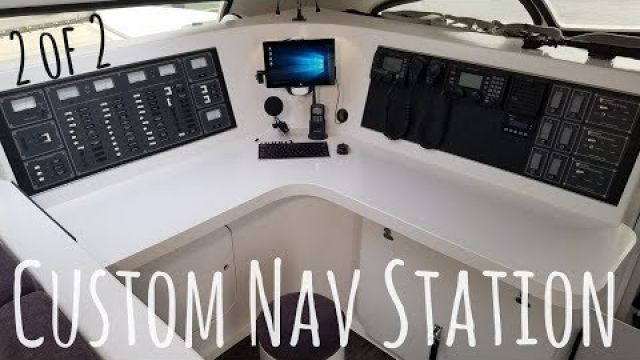
On this episode of Onboard Lifestyle we pick up where episode 14 left off and talk a bit about our electrical system then get some wires pulled in the nav st...
Closed Captions (CC):
[Music]
so back when we first started designing
this actually quite a bit of thought
went into our now station I mean this is
going to be the the central nervous
system of the boat I mean the brains of
the boat are right here everything kind
of leads through here we had to think
about places to put batteries wired
chases all behind the scenes and we
started with nothing we got it this all
out and just started over and building
it and designing it was was a lot of fun
I've had a had a blast doing it looking
at this now just a nice central hub for
me to do my thing it's straight below
here in this locker is the battery banks
these are trojan t105 six volt there's
three separate banks here in three
separate linked in three separate series
so we are generating 12 volts of
electricity with the total am powers of
675 amp hours and we're gonna start with
that and we'll see how it goes if we
need to add more I could always add more
but I'm trying to just replenish the
batteries fast enough that we don't have
to carry any more additional batteries
with all that additional weight so over
the years this whole area here was
originally designed to be an enclosed
queen-size berth that you access from
down here and you could almost feel it
still in here but it's all been carved
out previous owners had not just out and
put a desk in here we just excavated
everything out and started over I mean
this is obviously the place where you
need your nap station a forward-facing
nap station with nice visibility
that's what we did we just gutted it
yard it out every bit of wire actually
all the electrical was on this wall over
here when we purchased the boat and we
moved it to here so to get all that
wiring out a we pulled out two to
three hundred pounds of wiring out of
here just an amazing amount of wire then
we excavated everything out and just
rebuilt from the ground up it was a
quite the project tried to keep it as
light as we could actually we did use a
lot of foams and ultralight materials
and skinned everything with just a thin
layer of wet system epoxy and this is
what we came up with it's really
functional and it's a great place nice
central spot for us to run all of the
electronics room okay now that I've cut
a few items into the nav panels here
that'd be good idea to talk a little
about the electrical on board and we
started over actually we got it every
bit of wire off of this boat for a
couple of reasons one reason is that we
heard rumors that this boat was hit by
lightning in Florida I did find a lot of
damaged wire and corroded wire so wasn't
a bad idea to get rid of it but mostly
because we did such drastic changes to
the the boat over all that all the
wiring had to be removed to make the
modifications and why not upgrade at
that point and have a brand new wiring
system so let's take a look at a few
things here is our dog compass what are
you doing here is
our main panel and you can draw a line
straight down the center here this is
120 and this is 12-volt we have to shore
power leads running it shore power 1
which is tripped here handles this Bank
here which is just all of our normal 120
you know use we haven't hooked up the
refrigerator washer dryer battery
chargers hot water heater outlets etc
short power to handles all the heating
and air conditioning we have two 16,000
BTU Lobosco heating and air conditioning
systems in here look at this side 12
volt comes in through this main breaker
here and it is distributed throughout
the boat here now for every single one
of these switches all through here I
have these going to sub panels so let's
just pick one like here here's one
galley lights so let's go look let's
take a look at the gallery lights I have
them all tucked away in Nice hidden
spaces but here's here's the gallery
lights goes to a little blue sees fused
sub panel here so that one breaker comes
in power feeds power to this sub panel
and it's individually fused to every
single item in the Gowan and right now
we have five different light switches in
the galley and I still have room for one
more if we want to add one more from the
fuse it runs to a switch and I've made
all these switches but I can switch
these and turn on our LED lighting let's
go into the galley here
more switches here turn these on and
this runs a bank of LED lights above the
counters
I even tucked in some nice accent
lighting on shelves the LED is such low
amp draw it's kind of fun to play with
this and add is nice accent lighting
everywhere so for every switch there I
have another one of these blue C sub
panel somewhere on the boat I mean the
downside is we've got what 30 switches
so we probably have 30 these sub panels
and they're everywhere let's like look
at this Bank of bilge pumps here 6 bilge
pumps over it to a sub panel behind the
port this one is open for more
electronics and I'll be adding the
navigation and communication equipment
sub panels in there as well behind this
board it's getting there everything's
nice and organized and laid out and
functioning just like it's supposed to
believe it or not this is probably only
about half of the wiring that's going on
board but it's been a lot of fun laying
it out and I I enjoy this end of it so
here's how I do it looks like my dad's
coming back from the marine store again
he must be their favorite customer he
goes there like every single day let's
go see what he got
sweet there he is
[Music]
what did you get today just more stuff
actually I got some things that you're
gonna help me install right now Oh what
is it you'll see okay all right
so what'd you get just couple things we
need him he always need them the spool
of those we have 30 of them now and they
are necessary really
really hey I don't think I believe you
I think this is your OCD coming out and
maybe but you know what
I feel good about it I'm sure you do
well you I'll show you today today I get
to mount these sub panels in to the nav
station so first I have to open the nav
station up then I have to take the drill
yeah it looks pretty good
there you go yeah not bad at all okay
good job
[Applause]
[Music]
[Applause]
[Music]
[Music]
now that I've mounted more sub panels
I'll tell you what there are about the
first one is communication equipment
which is that one the next one is Knapp
station instruments the next one is
bilge pumps that one right there is
salon lighting and then the one that we
already have installed is master head
lighting good job you get a wire him up
now yes just kidding
okay now that Emma have this all
prepared for me my goal today is to get
some wiring in okay so the first thing
I'm gonna do is I have this USB port I
just put in I have another USB port
right up here I will pick probably this
one right here I need to run a lead from
the nav station instruments run a power
lead to the sub panel then I'll be able
to branch off start branching off some
of these items in the nav station the
other thing I want to accomplish today
is start wiring these bilge pumps here
I've got these six bilges I've got two
mounted in and I'll take another panel
maybe I'll put the builders here they're
closer in proximity so I'll put the
builders here I don't put the nav
station equipment here it makes a little
more sense and from let's see where is
bilge pumps right here so I'll run a
power lead from here over to this sub
panel and branch off my bilge pumps from
there then I could wire them to the
individual bilge pumps on board
[Applause]
[Music]
[Applause]
[Music]
[Applause]
[Music]
[Music]
[Music]
[Applause]
[Music]
[Music]
[Music]
okay so calculating out the wire size
that I need for my new bilge pump panel
here it's pretty simple I'm adding six
of these bilge pumps they run eight amps
at 12 volt so let's say we are running
three simultaneously we had some
catastrophic event where one hole is
underwater numbering three so that means
a total of what are you doing I know
you're mad total of 24 amps of power so
I'm under six feet from here to here so
24 amps of power I would need a 12 gauge
lead pretty simple to calculate now from
the panel now to the bilge pump is
different I just calculate how far each
lead is going to be let's say this one
is 30 feet 30 feet and it's gonna be
between us 14 and a 16 gauge so I'll up
it to a 14 just to play it safe but
pretty simple to calculate okay the next
step is now that I've got it tied into
the sub panel is to bring the wire
around and tie the lead into the main
panel here
pretty simple just route it in cut to
the right length and attach
[Applause]
[Music]
okay now that I've got my leads in to
these sub panels I've started wiring
some items in I just wired in my USB
charging station which runs right off of
the switch here and I put a second USB
up here that's kind of an odd space for
it but I'll show you why now I could
plug in I can use this as a charging
station or plug in a USB nap light so
let's see
they have instruments I now have a light
and let's check to make sure that my
charging station works I have power
there as well
so there we go
looks like my dad's finishing up his
project and thinks my mom's home hi
playin it up yeah we're gonna have to
get this all cleaned up because I'm
making ramen outside today get one
cleaned up oh okay
so the USB works USB works I'm at a
battery good plug that sucker in truth
see doesn't work genius
Oh Charlie you gotta turn the switch on
you can tell me that well okay nav
station instrument third one up in the
bottom right there
leave that on and okay now we have
something that works okay good job
[Music]
thanks for watching this week's episode
of onboard lifestyle if you liked it
then don't forget to give us a thumbs up
and subscribe to our Channel come back
next week when my dad shifts gears and
start working on a brand new project
that I see listen see you then good job
Onboard Lifestyle ep.16 Custom Catamaran Nav Station (2 of 2)
Uploaded by:
Onboard Lifestyle
•
Category:
Boat Building/Maintenance/Repair, Instructional
•
Added on
15 June 2018
Description
On this episode of Onboard Lifestyle we pick up where episode 14 left off and talk a bit about our electrical system then get some wires pulled in the nav st...
Closed Captions (CC):
[Music]
so back when we first started designing
this actually quite a bit of thought
went into our...
Closed Captions (CC):
[Music]
so back when we first started designing
this actually quite a bit of thought
went into our...