

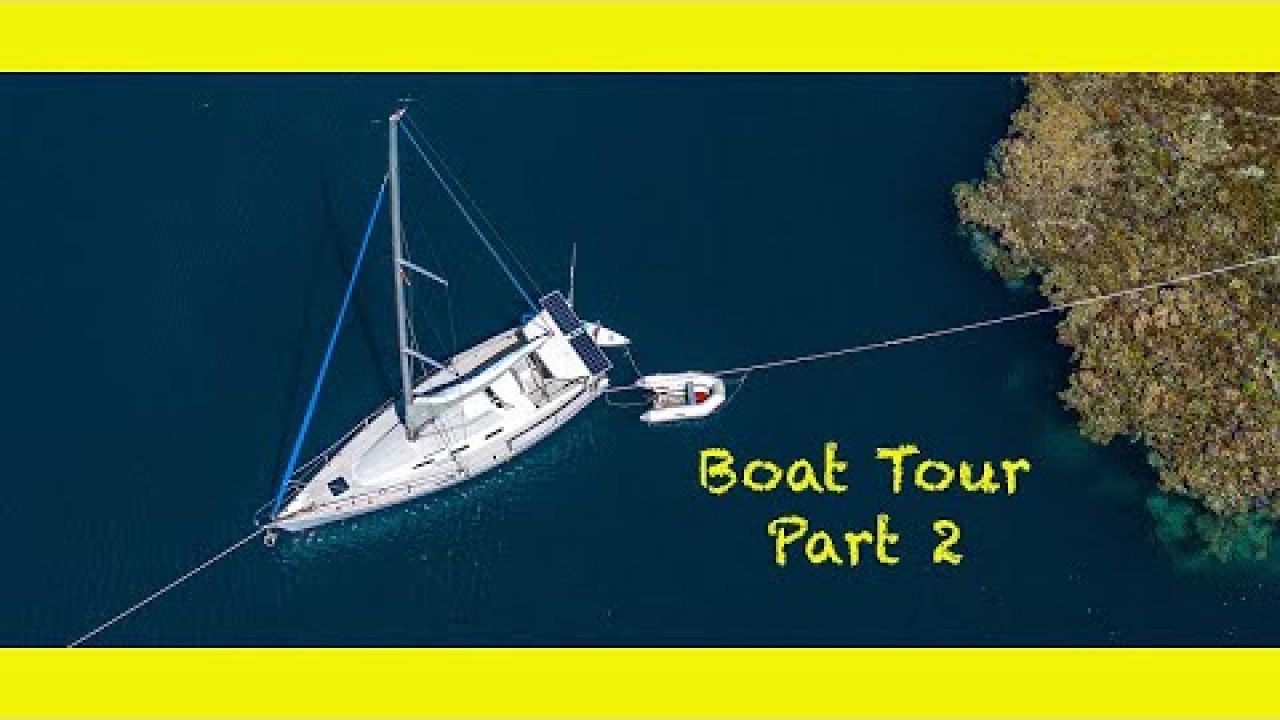
Boat Tour time. The last episode went down very well and here is the sequel, the outside of my boat explained. And its a long one! So many viewer have asked ...
Closed Captions (CC):
[Music]
good day to you all I hope you enjoyed
the last episode both to a number one
today I'm going to show you the boat the
actual boat what makes it go how I how I
can sail it single-handedly all these
sorts of things so as with the last
video I'm gonna start up on the bowel
and work my way towards the aft part of
the boat so when I bought the boat the
bow roller was made in a real
lightweight material so I rebuilt the
whole thing out of 10 mil 12 mil
stainless steel just because I knew when
you're pulling up the anchor especially
by myself and the anchors out there and
the winds blowing me this way that the
old one would have just been dawei so I
built a whole new one just before I left
I have a Manson supreme anchor I'm not
sure of the weight but it's definitely
holds the boat I think I have 60 meters
of 8 mil chain and about a hundred
meters of of nylon road to go with that
and I keep some fenders and and snubber
and the roads all down the bottom this I
think it is part of the racing
regulations that offshore boats need to
have watertight bulkheads so this boat
has a bulkhead up the front here so you
know if I would hit a container or
something hard no waters actually going
to cut ingress into the boat itself and
also one of the in the aft section I'll
show you that later just for the anchor
winch and yeah yeah I've got a Felix
filler for the jib the jib is it is
fractional rigged I had it
Riis to Sun shading on it before I left
also just had the whole thing checked
out and any loose threads researched
it's a hundred percent sail and it only
goes as far as the mass so there's no
overlap on this sail on the jib here are
two spinnaker pole
a very long and heavy one in a lighter I
guess you would call it a whisker pole
one thing I didn't mention in the last
episode was the fact that I don't have
any leaks on this boat and I know a lot
of you old salts out there won't believe
that because there's a you know there's
a saying that there is never a boat that
doesn't leak but I honestly have had no
leaks since I've been on the boat it
could be that if I was in the southern
ocean and it was very heavy water that
something would leak but until now and
in the storms that I've been in so far
there has been zero leaks and I put that
down to this boat being very very stiff
my last boat I know leaked a lot because
in any sort of waves that boat flexed
the whole hull flexed and when you have
flex over time things just start opening
up you know like around hatches and and
where I'm staunch and poles go through
the deck and things like that
when this flex this movement and then
over over time the Sikaflex or the
sealant that was used it goes hard and
that'll crack and then water will come
in there's the main hatch into the V
berth here we have the forward section
of the jack line where it attaches to
the deck and it goes all the way down to
the back of the boat this is what I clip
on to whenever I have to come on deck
when I'm at sea my dinghy sits right
here comes right back to the mast and it
comes up to the front of the hatch so I
can actually still open my hatch when
the dinghy is loaded which is very
important because that is as I said that
is my calling my my air conditioning if
I would have a bigger dinghy that it
would just cover that hatch and that's
such an important part of sleeping in
Anchorage is for me my dinghy is 2.6
meters long its aluminium Holt it's it's
very light and I have a 9.8 horsepower
which for me and one other person is
fine we can rip around but when is three
people on board I just have to go slow
with it but anyway so ties down here
very securely on three points I've never
had any problem and it's it's upside
down so any waves that come over the
front don't go in the dinghy it's very
safe here to the
now as you saw in the last video the
mast goes down through the bathroom to
the keel this is its point of entry a
nice big aluminium base plate for it
here and as you can see all of the
controls for the sails and the mast go
straight back to the cockpit
so reefing lines topping lifts spinnaker
halyard main halyard jib halyard x' they
all come back down through the two masts
back to the cockpit the van has a good
angle and a lot of power to keeping
there keeping the boom down and the the
mainsail shaped well going down wind
taking a look from the bottom of the
mast up to the top you see that this
bread is a very backward swept and very
wide the strength of this rig is quite
impressive the shrouds come down to the
very outside of the hull as you can see
here so this gives the rigging extra
width if you look at a lot of boats the
the shrouds actually come angle in
towards the center after leaving the
spreaders and for me that's just
engineering wise is just wrong you're
just rubbing the rubbing the rig of
strength the wider you can have the
shrouds out based on the boat the
stronger it's going to be a mess y-you
see a catamaran doesn't need many
shrouds because it's got such width
you're making a big triangle from the
top of the mast down also having the the
shrouds coming and the chain plates on
the outside of the boat there's also no
chance of leakage there a lot of boats
will have the chain plates going through
the deck and attached to a bulkhead
inside the cabin somewhere and this is
the number one place for leaks because
they are always moving when you're
sailing on the port tack or starboard
tack some of them are loose some of them
are tight depending on how strong the
windows there's always pressure changes
and that that's just opening up holes in
your deck all halyards on this boat
spectra or Dyneema
I'm not sure but very strong non-stretch
rope the sail is on a roll
tract and the main halyard is two to one
then it's got a pulley so it's a lot
easier to pull up you have to pull a lot
more rope obviously but it's a lot
easier to pull up alone the mainsail is
not your normal cruising Dacron I think
it is some sort of fancy racing material
with some UV tolerant taffeta layer over
it seems to be still in quite good
condition it still has a really good
airplane wing shape I have had to fix it
a couple of times so far but I'll try
and make it last because this is
probably a very expensive sail but next
time I have to replace it I don't think
I'll go for this fancy material I'll
probably go with a with a heavy ish
Dacron and just save a bit of money and
maybe lose half a lot of speed it would
be sad hate to lose speed but I don't
want to spend ten grand on a new sail
and I think the sail has three reefs the
third reef is very very deep and that is
sort of the storm sail as such I don't
know it probably comes down to maybe
eight square meters or something that's
just a guess but the whole mainsail size
is 43-44 square meters so on chelonian I
have two tracks for the head sail sheets
right now it's on the outside and have
also this one the reason we can do this
is because the rigging comes so far back
and I don't have an overlapping jib so
I'm free to do anything up here the
ropes are never in the way of the
shrouds the inside track is for going
upwind when I have it fully suited down
on this track I can go slightly under 30
degrees to the wind which is about well
an old score full full keel heavy boat
will probably not sail under 50 degrees
to the wind
so if you can imagine the winds come
from straight on and someone can only go
50 that's a lot more distance they have
to do if they're attacking backwards and
forwards so it's a huge huge difference
and then going downwind I use the
outside track it just means you have got
that extra width so that the sailors out
here already
it still sales to windward pretty good
on this outside track and if I'm only
doing it well I don't if I don't care
too much about how fast I'm going or if
I don't have to go exactly on 30 degrees
I'll just leave it on here but if it's a
long upwind and I am really trying to be
as efficient as I can I'll run it
through this track for sure it makes
about a difference of about 10 degrees
and probably it not how nice and wide
and free these walkways are up to the
front I mean I know this boat now I know
what to watch out for with my feet and
things like that
but there is really nothing to trip over
the the walkways are wide and smooth and
there's no tryouts going down through
the middle of them and I really really
like that
here we have the furling line going up
to the Furlow it comes back through this
clutch and it's just a hand hand pull on
the jib is relatively small so I never
have to use the furling line on a winch
I only I feel even in big storms just
just by hand maybe just point up into
the wind slightly pull it in a few reps
the clutch doesn't let it out again and
then when I need to to let the sail out
I just let the clutch off slowly and and
let some line out by hand jib sheets
come back through this turning block
here and then up to the primary winch
here we have all the controls for
sailing the boat basically as of as I've
said before I don't really have to ever
leave the cockpit I normally only leave
the cockpit when I leave the the
Anchorage I'll go forward and put the
halyard onto the mainsail and that is
about the only time I leave the cockpit
everything else is controlled from here
this is my driving position I can
control the whole boat from here
autopilot steering reefing drop in sales
tacking jobbing if I want to raise the
spinnaker I have to go forward I have to
pull the sock up but that's about the
only reason I only have four winches on
this boat two on each side all of them
in the cockpit there's no winches on the
mast all of these winches are identical
that Anderson 40s teas and this is also
a real good feature because it allows me
to carry less spares I just carry to
spare kits and between four winches
that's a real good feature because a lot
of boats will have six winches in the
cockpit two or three on the mast all
different sizes some of them self
tailing some of them not it's a bit of a
nightmare trying to show new people how
to use everything what they'll what
everything does whereas this is just a
very very simple layout so let me show
you what these controls all do here we
have clutches for some of the systems
what have we got here topping left jib
had a spare jib halyard a main halyard a
second reef they out haul for the main
Nova this side we have another topping
lift first a third reef first reef jib
halyard and a spinnaker halyard they all
come each one just I just used the winch
depending on which which thing I need to
use here I have a little ray marine GPS
plotter I installed this one myself it
is a completely standalone unit it just
has a power cable has its own GPS module
inside it's not connected to anything
else on the boat I actually do this on
purpose a lot of boats these days and I
guess it's I guess it's the electronics
manufacturers they were trying to lock
you into their systems but
there's a backbone and they try and wire
everything up together and your plotter
is connected to your AAS and your iOS is
connected to your radar and all of that
is connected to your autopilot and it's
just all one big system and it's it's
wireless and you can control it from
your iPad and all the stuff that sounds
really really great to me it sounds
really really complicated and it sounds
a lot like if you have a problem with
one thing you're probably gonna have a
problem with all of your things and to
be honest I don't need a wireless app on
my iPad that I can control the stuff
from it's right here
the other thing is if you get hit by
lightning and you have all this big one
system it's just all gone it's just all
dead it's fried this one is one plug in
the back if there's lightning around I
unplug it it's isolated it is easy to
undo and put in the oven if I need to
the oven of course is uh you know like
it's a steel box basically where it's
the most safe place to put electronic
things when there's a electric lightning
storms around so my autopilot is
standalone it does not have connect it
to anything else my iOS just goes on my
main plot of downstairs I don't have a
radar this blotter is completely
separate and none of its wireless and
none of it can connect to anything else
maybe old-school but I think if I have
what problem with one thing I have
backups for everything and it won't
migrate to other other other parts of
the system this is the tiller I'm very
happy to have a tiller in this boat and
not a wheel obviously most people will
prefer a wheel but I think it just makes
them feel like they're in a big boat and
not a not a laser or some optimist or
something but I really like the fact
that when it's up I have nothing else in
the in the cockpit corner thing I got a
knife and some pliers on there and I use
them in the cockpit a lot so when I'm
going into the wind and heeling quite a
bit you actually sit with your butt over
the edge here and it's very comfortable
because you don't you don't fall down
into the cockpit and just steer steel
with this it's like a big laser
basically this boat is also very
to balance the sales on and and this is
really you can really just steer this
with one finger it just sails along by
itself has a really big rudder a big
blade rudder and it steers so smoothly
it's so so good the Dodger is very well
built it's quite small that it doesn't
offer a lot of protection is one thing
that I wish I had a little bit more
protection in the cockpit but yeah it's
a compromise for racing I think as a
window here in the middle that can open
up to 160 watt solar panels that I've
put on there myself HF radio aerial you
have speed through the water boat speed
I'll set this up here we have speed over
ground which is a GPS speed speed over
the ground is sort of what I'm
interested in that's how how fast we're
going across the face of the earth
basically but the other one speed
through the water is the speed the boats
actually going compared to the water
around it so by comparing those two
different speeds I can tell how much
current there is if they're both thus
showing the same speed I know that
there's no current and that's what we're
actually doing if there's a two-knot
difference between them I know that I've
either got 2 knots of current with me or
2 knots of current against me second
down here we've got water depths right
under the boat over here we've got the
wind speed and direction I'm up here is
the autopilot up here this is for the
vang and do everything all the ropes all
the lines and sheets are all put away in
these nice bags along the sides here so
the cockpits are very tiny because of
that and if you if I were sort of
zooming back yeah you can see that the
cockpit is very very empty so very tidy
and easy cockpit and this is yeah this
is my view when I'm sailing
also a very good view of the of the
sails so I can keep the sails tuned
really well the only thing is as I said
there's there's a little bit lacking in
protection for example if if it's if
it's a if there's a lot of a lot of wind
and rain I'm under I'm undercover here
and this is where I sit and it's nice
having this rope bag as a Beck backrest
one of the alterations I did to the boat
when I first got it and I'm quite proud
of it or I'm really happy I did it
anyway it was a Main Street traveller
that went straight across here you can
see some marks haven't really painted
them very well because I like to sleep
in the cockpit when it's nice weather
and I'm you know travelling offshore
there was no flat place in the cockpit
to go to sleep that traveler had stood
up a couple of inches
I could imagine just banging it straight
on my shins every time at night or
whatever I when I wasn't taking care I
just didn't like the idea of having that
traveler in the cockpit and so I just
came up with it basically the triangle
shading system here and I've reinforced
underneath inside the boat here and I
put pet eyes on both sides as you can
see and so how it works is I just let
one loop and I pull the other one off
and the boom goes across to the other
side and it's the same like a traveler
but it means that there's a triangle and
I can actually pull the boom down on all
points of sail nearly so I have really
good sail shape control through that but
also means if I'm tacking going upwind I
can just leave the boom pretty much
centered tech deal with the the jib and
then just retune this but the booms not
flying over to one side and bashing over
the other side so that's really good and
when I'm going down wind all I do is
unhook that yeah
hook it to this pad I and then I also
have a preventer so it's it's a very
good system that I've I sort of lucked
into in a way I did it with this purpose
in mind but I didn't realize it was
working out this good and so far I have
nothing no regrets and nothing bad to
say about this system there is a hatch
and this has the life raft and a hose
but it has a six-man life raft it is
attached to this point here and all I
have to do in the sad horrible event
that I would want to use this thing is
lift it out and slide it off the back of
the boat
they're quite heavy it's surprisingly
heavy and if the amount of people I see
they've them downstairs somewhere
baffles me that they think that they'd
be able to ever get it out from
downstairs in a time of panic and you
know there's so many things probably
going to be happening in that moment
when you decide to abandon ship that
hauling a 50 or 60 kilo drum from
downstairs and you know the boat's
probably going to be going up and down
in a six meter waves and you got water
sloshing around and you think you're
going to get that from down there out
the back of the boat I highly doubt that
I think a lot of people carry a life
raft to offset the fear factors I think
I would have got that as a last resort
but actually thinking about how to use
it I think a lot of people go that far
there's also a crash box crash bulkhead
in the aft part of the boat it basically
goes through here right in front of the
rudder post so if the rudder would get
ripped off completely water is still not
going to come into the boat and this is
a real big feature it also means that
these hatches here at the back and not
part of the main cabin so I can keep my
fuel my spare fuel I got diesel petrol
I've got 150 litres of jerrycans down on
these sides one thing you might have
noticed on my deck I don't have it
cluttered up and most cruising boats
will have five or six tier
ken's tied to the rails and they'll have
all sorts of junk just tied around all
over the boat which a those things being
in the Sun is not great be it's easy for
people to come and steal your fuel and
see and most importantly when you're at
sea and you've got a something happened
you've broken a rope or a shackles come
undone in a storm and you have to go up
front and you're tripping over all this
crap and you've got to tie it down with
all these different ropes and you're
tripping over that and in a big storm
they're probably going to come loose
depending on you know you didn't
remember to tie them up properly and so
it's just it's just a bad idea to have
have stuff on deck down on this side I
have some more jerry cans and some
diving equipment things like that some
tarpaulins and also the autopilot it
goes here straight on to the steering
quadrant this the system is a Raymarine
linear drive one it's called it's the
same one I had on my last boat molasse
boat was more than double the weight of
this with a full keel and a big heavy
heavy rudder so this auto pilot handles
jahaly on with probably half the effort
of thereof on my last boat because of
that this autopilot will probably last
twice as long as well but I have spares
for it I talked to a man in Mooloolaba
in Australia who's worked his whole life
with my marine and he told me he has
never come across a autopilot braking
for other than for three reasons
it was the electric motor in the drive
unit it was the fluxgate compass and
what was the third I can't remember the
third one but anyway I have bought
brand-new spares of all of those three
things so that was a good piece of
advice for him so I feel pretty secure
the autopilot for me is my crew member I
couldn't do this without it basically it
allows me to go to sleep this this unit
has just never failed me I've just
pushed on as soon as I
get out of the Anchorage basically and
it steers me everywhere steers perfectly
so there's no reason not to love it it's
my it's my crew member that I never have
to feed or talk to these hatch on the
side this is also part of the bulkhead
is here so these are also not a part of
the main cabin here I have spare ropes
the GPS head for the chart plotter
downstairs is mounted in here and then I
have grease done fishing gear things
like that and all the ropes over on this
side I have my gas bottles some fishing
gear as well but have my gas bottles the
gas all come stays inside so this this
what I've got one two three four five
five gas bottles the small ones are only
two kilos and the bigger one is four
kilos so all together with these five
gas bottles I have 12 kilos of gas and
this lasts me a whole season so I only
have to fill up once per year so across
the back of the boat here I have these
safety lines strong stainless steel
lines and it stops me falling out the
back basically it's a very open cockpit
any water that comes in go straight out
the back but it you know it means you
have to be careful not to fall out
urinating off the offer boat is I think
statistically the highest chance of
falling overboard and dying
most people have to climb out of their
cockpit and go and hang on to it to a
safety line the only comes up to their
need and the boats going up and down
here when I'm standing up it comes up
over my waist and I've got the back stay
got handles everywhere so it's a very
safe place to urinate off the back of
the boat which is hey let's you've got
to do it a few times every day here is
where my outboard motor goes on this one
down here hooks on to the back back here
we have a hydro vein unit wind vane yeah
and I install this this hi drone before
leaving Australia last year as a backup
auto pilot but for me more so to have a
spare rudder a hydrophone unit is quite
unique and it uses its own rudder most
wind veins you know have control lines
coming to the tiller or wheel hydro vein
just steers itself with its own rudder
so for me having a spare rudder in case
mine would fall off or break it's a big
safety factor so in in the case that my
I don't know a tanker or something a
tanker I would swing on to coral and
break my rudder or it just broke or fell
off or something in the water hit it in
a whale or something because it is it's
a 2 meter blade that goes down to the
water with no sched protection nothing
like that so if it did get snapped off
and it is one thing I do think about
it's a very uh you know it's a very
unprotected part of the boat really so
having the hydro vane rudder as a backup
gives me a good peace of mind I haven't
had to use it yet and I don't use it as
a wind vane even though it works fine as
it went vine I prefer to use my
Raymarine electronic autopilot each
water tank port and starboard has its
own fill a hole and this is also how I
collect water from from when it's
raining so basically what happens
whenever it starts raining if I see that
it's you know it's a decent squall or
you know it's going to be prolonged
rainfall I'll come out with a broom and
I'll clean the whole decks
once it starts raining and I'll get a
shower at the same time I'll clean all
the salt off the decks of everything and
then I'll put my little little damn
walls up and then the entire deck of the
boat is basically a water catchment area
and I've been amazed on the amount of
water I can catch in a short time I've
filled up my tanks probably three four
hundred litres in 30 40 minutes of I
mean here you get when you get a
downpour it's a proper downpour
it's basically solid water but I've
filled up my tanks there's just been
water pouring into these holes filled up
my tanks in the span of 30 40 minutes
and that's another six weeks of sailing
for me without having to go and fill up
with
water so it's pretty amazing the
backstay on Chalian is is spectra or
Dyneema and it is non structural as in
the rig doesn't need the backstay for
strength the backstay on Chihuly on is
just for shaping the mast so about
tensioning or loosening the backstay I
can shape there the curve of the mast
and also the tension of the force day we
noticed that the cockpit is pretty
rough-looking it is very much a working
environment for me I just drag fish
straight into here I work on the
outboard this is my workshop so the
paint is taking a hiding in here it
doesn't bother me too much I don't care
you know my my boat's not a show item
it's not a speaking span in vironment
that a lot of people you know a lot of
people spend all their time doing that
keeping their boat perfect I go sailing
I use my boat and my view on is every
3-4 years when I'm in a good location
like next year in langkawi it'll be a
time when I lift the boat out of the
water for a month or two and repaint
their cockpit for example and I'll refit
things and make everything look really
nice again but in between these these
periods of refitting I just use the boat
I don't really get upset when I scratch
something or when I drop at all and it
chips some paint it doesn't bother me
too much to be honest I am I'm by myself
most of the time and be it's you know
life's too short to worry about little
things like that like if I'm scratching
the boat because I'm pulling fishing it
means I've just caught some awesome fish
and I'm going to eat good food and you
know I'm happy about that I'm not
worried about the blood getting
everywhere and things like that
as you can see from the footage here and
the pictures Chalian has a very
streamlined underwater profile there's
not much of her in the water compared to
my last boat here as a full-size full
keel
there's probably 30% less actual wetted
area on cherylin and there was on that
boat so obviously that makes a big
difference in speed she's got quite a
flat bottom quite wide at the back fin
keel with a torpedo bulb on the bottom
a big blade rudder 2 meters long Chalian
draws exactly 2 meters of water which
allows me to get into most Anchorage's
and the advantages of having a slightly
deeper killed and especially the big
bulb on the bottom it allows me to carry
much more sail and carry the sail for
longer before half the reef just because
of the pendulum the weight on the bottom
so you know you're not you're not
healing as as much or as fast the more
about heals the less efficient it
becomes the less higher you bafta point
because the sail is like an aircraft
wing it doesn't the wind doesn't push
you along it actually pulls you along
most of the time it's it's aerodynamic
so the fin under the water does the same
thing it actually creates lift that's
why often when you when you you finally
reef and you actually start going
slightly faster or at least as fast but
you're not healing as much it's because
the boat's more efficient so having a
big bob on the bottom of the fin
obviously helps us two and a half time
it obviously helps keep the boat more
upright in very stormy conditions I
might want to hook my harness onto
either of these two anchor points just
in case there was huge waves coming over
the boat I wouldn't get thrown out this
tends to be my spot of choice for when
I'm sailing in good weather defender
here it's a nice big fender good
backrest and I can brace myself well on
this pole and on the cable here and my
feet are in a good spot and I can see
the whole way down the boat here down
the front I can see everything and it's
just a real nice spot there's always
some breeze I'm under shade from the top
here and I'll often just bring a book
and sit back in here and read for hours
on in or listen to a podcast or whatnot
or just listen the sound of the water
coming out the back of the boat is also
a beautiful sound the faster you go the
louder it gets I love it you get up
around 9 10 knots and this thing it
starts roaring he keeps me up at night
sometimes anyway let's come to the end
of the boat tour I think that's about
all I've got to show you without
spending hours and hours more if you
have any questions if I didn't cover
things either from the first one or this
one please a comment below ask me
questions
we'll definitely get back to you as I
said in the first one this is my home
for a large part of the year
I love living on board sure hey Leon I
love the opportunity she gives me to go
and visit great off-the-grid places my
footprint is tiny when I'm living on
Shelly and the solar panels just give me
all the energy I need I have enough
water I catch my food I find my food I
bake my bread I have everything I need
here and a lot of things that I don't
need like the internet queues waiting
lines stress bad press negativity in in
the general public politicians that
drive me crazy with their lives I don't
have any of that on this boat and it's
such a simple beautiful life and I've
never felt more comfortable my own skin
to be honest
then since I've started living on che
Leon I'm really not doing this to try
and show off or show that I've got a
better life or anything like that I just
hope it inspires some people that it is
possible I have no background in sailing
I didn't start even knowing sailors
there was no inspiration of of an uncle
or brothers or someone who did sailing
it was just something I decided to do
and I hope that inspires some of you it
is possible you don't need a great
amount of money my first boat costs
40,000 Australian dollars it's it's a
lot of money you know if you just got
cash in your wallet but in terms of what
people spend on an apartment I was
spending 20,000 a year on an apartment
in Zurich that I hardly ever lived in
two years of that and I had my first
boat and I've never been happier so you
know if you look at it that way it's not
a big amount of money for a huge amount
of happiness and satisfaction so anyway
that's a long video now about this I
would like to end us up by that again
thanking my patrons you're all a
wonderful mob I really don't know how to
express my gratitude when I first
started making these videos I'm not sure
patreon even existed but if if it did I
didn't know about it
some of you my very first patrons were
were the ones that asked me to start a
patron account so you could support me
and that blew me away I never started
making these videos to make money the
interaction with you guys the amount of
support and and constructive criticism
and just general good vibes that you
guys give me every time I put a video
out it's just it's mind-blowing it's so
good like yeah it really really makes it
worthwhile meet me investing this much
time and effort into making these videos
so I say every video but I really mean
it too so thank you very much to all my
patrons to all you others who like
watching my videos I hope you give my
videos a big thumbs up and share them if
you're not subscribed please do and if
you subscribe it only makes sense to
push the notification spell so you know
when I put another video out that's it
that's all
thanks until next time enjoy have a good
life
bye bye
Uploaded by:
Vernon Deck
•
Category:
Sailing, General Vlogs
•
Added on
08 March 2020
•
Location:
Indonesia
Description
Boat Tour time. The last episode went down very well and here is the sequel, the outside of my boat explained. And its a long one! So many viewer have asked...
Closed Captions (CC):
[Music]
good day to you all I hope you enjoyed
the last episode both to a number one
today I'm going...
Closed Captions (CC):
[Music]
good day to you all I hope you enjoyed
the last episode both to a number one
today I'm going...
Comments/Likes

Natasha
Indonesia so tropical !! Bali is awesome
6 years ago


Bianca Sabrosa
⚓️⚓️⚓️???⛵️⛵️⛵️
6 years ago